Meraki School of Higher Education helps you secure admission into the right Central, State, Private or Deemed to be Universties - Full-Time or Part-Time. From choosing your research area and proposal to the presentation and interview, we mentor you at every step.
Last Date for submission of Admission Form: 08th Oct, 2026. Date of Entrance Test: 17th Oct, 2026.Last Date for submission of Admission Form: 15th Oct, 2026. Date of Entrance Test: 17th Oct, 2026.Last Date for submission of Admission Form: 15th Nov, 2026. Date of Entrance Test: 27th and 29th Nov, 2026.Last Date for submission of Admission Form: 30th Nov, 2026. Date of Entrance Test: 05th Jan, 2027.Last Date for submission of Admission Form: 08th Oct, 2026. Date of Entrance Test: 17th Oct, 2026.Last Date for submission of Admission Form: 15th Oct, 2026. Date of Entrance Test: 17th Oct, 2026.Last Date for submission of Admission Form: 15th Nov, 2026. Date of Entrance Test: 27th and 29th Nov, 2026.Last Date for submission of Admission Form: 30th Nov, 2026. Date of Entrance Test: 05th Jan, 2027.
2008
Guiding scholars since
200+
Ph.D. programmes
16
Faculties covered
1:1
Personalised mentorship
About Meraki
Guidance That Comes From the Heart.
Established in 2020, Meraki School of Higher Education guides students for admission into Central, State, Private and Deemed to be Universities — for full-time or part-time Ph.D. The name Meraki means doing something with your heart and soul, and that is the spirit we bring to every scholar we mentor.
How We Help
End-to-End Support for Your Doctorate.
University Selection
We identify and shortlist the right Central, State, Private or Deemed to be University based on your academic profile, research interest and eligibility.
Topic Selection
We work with you to define and refine a focused research topic and proposal that aligns with your domain expertise and the university's research priorities.
Presentation
We prepare you for the research proposal presentation — structuring your synopsis, building your slides and boosting your confidence before the panel.
Interview
Expert coaching for the personal interview and viva-voce, covering research aptitude, subject knowledge and clear articulation of your proposed area of study.
Application Support
End-to-end help with documentation, form submission and continuous monitoring of each university's admission schedules and entrance notifications.
Ph.D. Faculties
Agriculture
Allied Health Sciences
Ayurveda
Basic Sciences & Humanities / Liberal Arts
Commerce & Management
Dentistry
Education
Engineering and Technology
Interdisciplinary Sciences
Law
Art and Design
Media Studies
Medicine
Nursing
Performing Arts
Government
Pharmaceutical Sciences / Physiotherapy
Economics
Applied Mathematics
Biotechnology
Note:* Choose a faculty, then tap a programme to see its entrance-exam dates.
If your discipline is not listed above, please submit an enquiry — our guidance extends across a wider range of research areas.
Eligibility & Admission
Criteria and steps vary across Universities — here's the general path, and where Meraki guides you through each stage.
01
Master's or 4-Year Bachelor's Degree
1-year Master's after a 4-year Bachelor's, or 2-year Master's after a 3-year Bachelor's — minimum 55% marks in aggregate.
Candidates holding a 4-year Bachelor's degree with a minimum of 75% marks in aggregate may apply directly to a Ph.D. programme under NEP 2020 — a Master's degree is not a prerequisite.
5% relaxation for SC / ST / OBC (non-creamy layer), Differently-Abled and EWS candidates.
Equivalent qualifications from foreign institutions accredited by a recognised authority are also accepted.
02
Entrance Examination
Candidates who have qualified UGC-NET / UGC-CSIR NET / GATE / CEED or similar national-level tests may be admitted on the basis of an interview, without a separate entrance test.
Institutions may conduct their own entrance test with a syllabus comprising 50% Research Methodology and 50% subject-specific content.
A minimum of 50% marks in the entrance test is required to be called for the interview.
5% relaxation in entrance test marks for SC / ST / OBC, Differently-Abled and EWS candidates.
03
Interview & Presentation
The number of candidates called for interview is determined by the institution based on the number of Ph.D. seats available.
Final selection weightage: 70% for the entrance test and 30% for the interview / viva-voce performance.
The interview assesses the candidate's research aptitude, subject knowledge and proposed area of study.
Guidance & Counselling for Ph.D.
1
Selection of Universities
2
Complete Guidance for Ph.D.
3
Topic Selection
4
Presentation / Synopsis
5
Personal Interview (Mock)
6
Guidance in Ph.D. Journey (if required)
Ph.D. AchievedGuided by Meraki, every step of the way.
Scholar Stories
Guided by Meraki, Admitted With Confidence
“
Joining Meraki School of Higher Education was one of the best decisions I made. The online sessions on Ph.D. admission by Rajni Ma'am were well planned, and with their help I secured admission for my Ph.D. at DMIHER. It is a great place for research-related counselling.
Anubhav Chaudhary
Ph.D. MLT (DMIHER) · Guided by Meraki
“
I highly recommend Meraki School of Higher Education. They secured my Ph.D. admission smoothly and gave excellent preparation for the written test, interview and topic selection. They boosted my confidence by showing how my strong fashion-industry experience makes me fully capable of succeeding in a Ph.D. Special thanks to Rajni Ma'am and Ms. Simran for their extra-mile support. If you have valuable experience and dream of a Ph.D., take the step — the right guidance makes it possible!
Sukhvinder
Ph.D. Fashion Technology (LPU) · Guided by Meraki
“
I had an amazing experience with Meraki School of Higher Education. They helped me with my Ph.D. admission, entrance, interview and topic selection, and supported me from the very beginning, providing continuous support throughout the entire process. Every query was answered promptly, and every task was handled with great professionalism and care. Their dedication, transparency and commitment gave me confidence at every stage. I am truly grateful for all their efforts.
Avnish Mishra
Ph.D. MLT (DMIHER) · Guided by Meraki
Ph.D. Journey
Request Admission Guidance
Take the First Step Toward Your Doctorate.
Share a few details and our team will reach out with university options, an eligibility check and a personalised admission plan.
Disclaimer: The ₹50,000 fee covers Meraki's guidance and processing services only. It does not include university application, entrance examination, tuition or any other fees charged directly by the university, which vary by institution. Charges are subject to change and are non-refundable once the process has begun.
Last Date for submission of Admission Form: 08th Oct, 2026. Date of Entrance Test: 17th Oct, 2026.
Admission Schedule
Last Date for submission of Admission Form: 15th Oct, 2026. Date of Entrance Test: 17th Oct, 2026.
Admission Schedule
Last Date for submission of Admission Form: 15th Nov, 2026. Date of Entrance Test: 27th and 29th Nov, 2026.
Admission Schedule
Last Date for submission of Admission Form: 30th Nov, 2026. Date of Entrance Test: 05th Jan, 2027.
Admission Schedule
Last Date for submission of Admission Form: 08th Oct, 2026. Date of Entrance Test: 17th Oct, 2026.
Admission Schedule
Last Date for submission of Admission Form: 15th Oct, 2026. Date of Entrance Test: 17th Oct, 2026.
Admission Schedule
Last Date for submission of Admission Form: 15th Nov, 2026. Date of Entrance Test: 27th and 29th Nov, 2026.
Admission Schedule
Last Date for submission of Admission Form: 30th Nov, 2026. Date of Entrance Test: 05th Jan, 2027.
Shorts
Short Videos
FAQs
Frequently Asked Questions
What are the eligibility criteria for admission to a Ph.D. programme?+
A 1-year / 2-semester Master's degree after a 4-year / 8-semester Bachelor's programme, or a 2-year / 4-semester Master's degree after a 3-year Bachelor's programme, with a minimum of 55% marks in aggregate (or equivalent grade).
Candidates holding a 4-year / 8-semester Bachelor's degree with a minimum of 75% marks in aggregate are eligible for direct Ph.D. admission under NEP 2020, without a Master's degree.
Candidates who have completed an M.Phil. programme with a minimum of 55% marks in aggregate (or equivalent grade) are also eligible.
Equivalent qualifications from foreign educational institutions accredited by a recognised assessment and accreditation authority are accepted.
A relaxation of 5% marks is applicable for candidates belonging to SC / ST / OBC (non-creamy layer), Differently-Abled and Economically Weaker Section (EWS) categories, as per UGC norms.
What is the duration of a Ph.D. programme?+
The Ph.D. programme has a minimum duration of 3 years (including course work) and a maximum duration of 6 years from the date of admission.
An additional 2 years may be granted through re-registration as per the institution's Statute / Ordinance, bringing the maximum permissible period to 8 years.
Female Ph.D. scholars and Persons with Disabilities (with more than 40% disability) are entitled to a further relaxation of 2 years, extending the maximum permissible period to 10 years.
Female Ph.D. scholars may avail Maternity Leave / Child Care Leave of up to 240 days over the entire duration of the programme.
What is the procedure for Ph.D. admission?+
Admissions are governed by UGC guidelines and the Central / State Government reservation policy applicable from time to time.
Candidates who have qualified UGC-NET / UGC-CSIR NET / GATE / CEED or similar national-level tests may be admitted on the basis of an interview alone.
Institutions may also admit students through their own Entrance Test, with a syllabus comprising 50% Research Methodology and 50% subject-specific content.
A minimum of 50% marks in the entrance test is required to be shortlisted for interview; 5% relaxation applies for SC / ST / OBC, Differently-Abled and EWS candidates.
Final selection is based on a weightage of 70% for the entrance test and 30% for the interview / viva-voce.
Institutions are required to publish a prospectus on their website specifying available seats, subject-wise distribution, admission criteria and procedure, and must maintain an updated list of Ph.D. supervisors and registered scholars.
Who can be a Research Supervisor, and how many scholars can a supervisor guide?+
A permanent Professor or Associate Professor holding a Ph.D. with at least 5 peer-reviewed publications, or a permanent Assistant Professor holding a Ph.D. with at least 3 peer-reviewed publications, may be recognised as a Research Supervisor within their own institution.
A supervisor may guide a maximum of 8 scholars (Professor), 6 scholars (Associate Professor), or 4 scholars (Assistant Professor) at any given time.
Adjunct Faculty members may act only as Co-Supervisors, not as primary Research Supervisors.
A Co-Supervisor from the same or another department or institution may be appointed with approval of the competent authority; for interdisciplinary research, a Co-Supervisor from outside the department may also be permitted.
Faculty members with fewer than 3 years remaining before superannuation may not take on new research scholars; they may continue supervising already-registered scholars and may serve as Co-Supervisors after superannuation, but not beyond the age of 70 years.
In the event of relocation of a female Ph.D. scholar, research data may be transferred to the new institution, subject to applicable conditions and full credit being given to the parent institution and supervisor.
Can international students apply for a Ph.D. programme in India?+
Yes. International students may be admitted to Ph.D. programmes at Indian Higher Educational Institutions (HEIs).
Each supervisor may guide up to two international research scholars on a supernumerary basis, over and above the regular permitted number of Ph.D. scholars.
HEIs are permitted to determine their own selection procedure for international Ph.D. applicants, in accordance with the guidelines issued by the relevant statutory and regulatory bodies.
What are the course work requirements for a Ph.D. programme?+
A minimum of 12 credits of course work is mandatory, which must include a course on Research and Publication Ethics (as notified by UGC) and a Research Methodology course. UGC-recognised online courses may also be counted towards the credit requirement.
All Ph.D. scholars, regardless of discipline, are required to undertake training in teaching, pedagogy and academic writing related to their research subject during the doctoral period.
Scholars may be assigned 4–6 hours per week of teaching or research assistantship, including tutorials, laboratory work and evaluations.
A minimum of 55% marks (or equivalent grade on the UGC 10-point scale) in course work is required to remain eligible to continue in the programme and submit the thesis.
How is a Ph.D. thesis evaluated and what is the viva-voce process?+
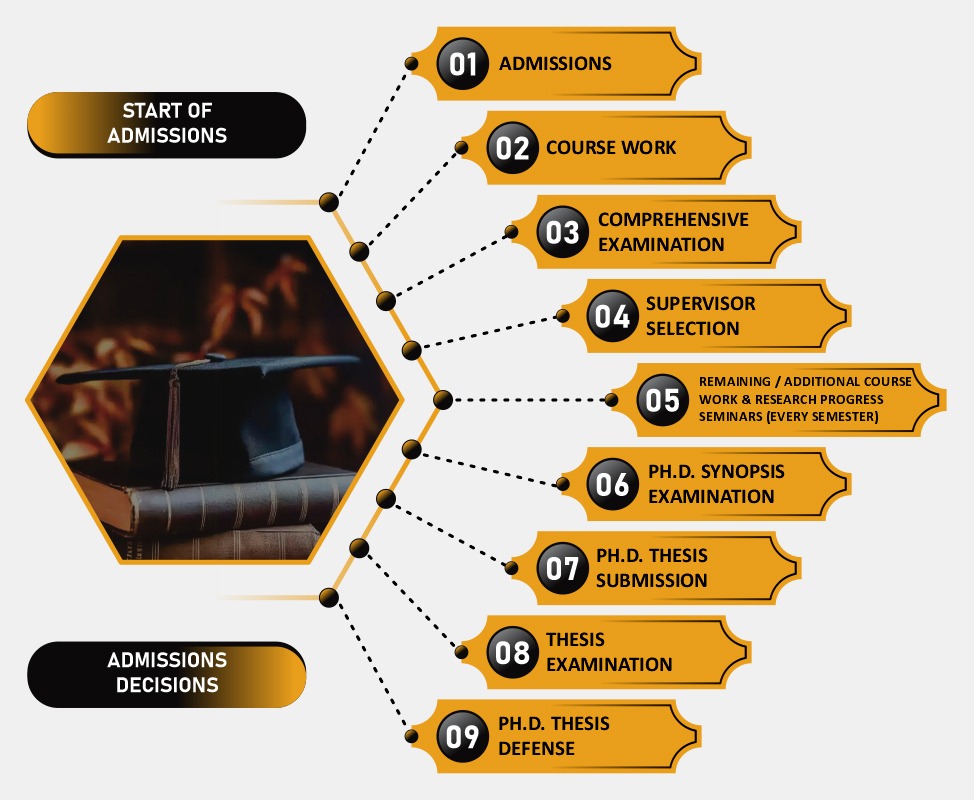
Upon satisfactory completion of course work, the scholar undertakes research and produces a draft thesis. A pre-submission presentation before the Research Advisory Committee — open to all faculty and scholars — is mandatory before the thesis may be submitted.
The scholar must submit an undertaking of no plagiarism and a certificate from the Research Supervisor confirming the originality of the work and that it has not been submitted elsewhere.
The thesis is evaluated by the Research Supervisor and at least two external examiners who are subject experts not employed by the institution; wherever possible, one examiner should be from outside India.
The viva-voce is conducted only if both external examiners recommend acceptance of the thesis. It is open to faculty, scholars and students and may be held online.
If one examiner recommends rejection, the thesis is referred to an alternate external examiner. If the alternate examiner also does not recommend acceptance, the thesis is rejected and the scholar is declared ineligible for the award of the Ph.D.
The institution must complete the entire evaluation process, including declaration of the viva-voce result, within six (6) months from the date of thesis submission.